NO.17 You are troubleshooting a signal strength issue when you notice that the signal strength changes from -70 to -73 dBm as you move from one room to another.
In this scenario, what is happening?
According to the Wikipedia article on dBm1, a 10 dB increase in level is equivalent to a ten-fold increase in power, and a 10 dB decrease in level is equivalent to a ten-fold decrease in power. Therefore, a 3 dB change in level is approximately equivalent to doubling or halving the power.
In this scenario, the signal strength has changed from -70 dBm to -73 dBm, which is a 3 dB decrease in level. This means that the signal strength has halved, or decreased by 50%. To calculate the ratio of the signal strengths, we can use the following formula:
fracP1P2=10fracx1x210
where P1 and P2 are the powers in mW, and x1 and x2 are the levels in dBm. Plugging in the values from the scenario, we get:
fracP1P2=10frac-70-(-73)10=10frac310approx1.995
This means that the power at -70 dBm is about 2 times higher than the power at -73 dBm, or equivalently, the power at -73 dBm is about 0.5 times lower than the power at -70 dBm.
NO.24 Click the Exhibit button.
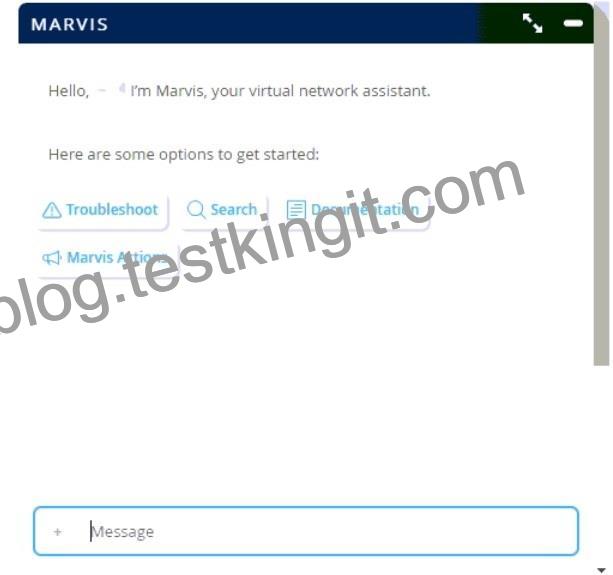
Referring to the exhibit, which Marvis language would you use to query Mist about an issue?
Referring to the exhibit, the Marvis language that you would use to query Mist about an issue is natural language. Natural language is the language that humans use to communicate with each other, such as English, Spanish, or Hindi. Natural language is different from formal or programming languages, such as SQL, Python, or query language, which have strict rules and syntax.
Marvis is a virtual network assistant that allows you to interact with the Mist network using natural language commands. You can type or speak your queries to Marvis in plain English and get answers in a conversational manner. For example, you can ask Marvis questions like “Why is my Wi-Fi slow?” or “How many devices are connected to AP1?” or “Show me the throughput of SSID2”. Marvis will understand your intent and provide relevant information, insights, and actions.
Marvis uses natural language processing (NLP) to analyze and interpret your queries. NLP is a branch of artificial intelligence that deals with the interaction between computers and human languages. NLP involves various tasks, such as speech recognition, natural language understanding (NLU), natural language generation (NLG), sentiment analysis, machine translation, etc.
NO.25 Mist Insights will provide detailed information about which two categories? (Choose two.)
Mist Insights is a feature that provides detailed information about the network performance and user experience of your Mist-managed sites, access points (APs), and clients1. You can use Mist Insights to monitor, troubleshoot, and optimize your network by accessing various types of data and analytics collected by the Mist cloud1.
Mist Insights allows you to view insights for different contexts, such as the entire site, a specific AP, or a specific client2. You can select the context from the dropdown menu on the Insights dashboard in the Mist portal2. Depending on the context, you can see different sections of information and insights, such as site events, client events, AP events, applications, network servers, pre-connection and post-connection metrics, current site properties, current WLANs, access points, clients, and wired switches2.
Therefore, AP and client are two categories that Mist Insights will provide detailed information about. You can learn more about Mist Insights from the Juniper Networks documentation or the Mist documentation.
NO.37 You want to review client information about a specific AP.
In this scenario, where in the UI would you look?
If you want to review client information about a specific AP, you can go to the Access Points page in the Mist UI. The Access Points page shows a list of all the APs that are managed by your site, along with their status, model, firmware, location, and other details1. You can also use the search bar or the filter options to find a specific AP by its name, MAC address, serial number, or tag1.
By clicking on an AP from the list, you can access the AP Details page, which shows more information about the AP, such as its configuration, events, alerts, and insights2. On the AP Details page, you can also see the client information about the AP by clicking on the Clients tab2. The Clients tab shows a list of all the clients that are associated with the AP, along with their status, MAC address, IP address, hostname, role, SSID, VLAN, and other details2. You can also use the search bar or the filter options to find a specific client by its name, MAC address, IP address, or tag2.
By clicking on a client from the list, you can access the Client Details page, which shows more information about the client, such as its connection history, events, alerts, and insights3. On the Client Details page, you can also see the performance metrics of the client, such as its signal strength, data rate, latency, packet loss, throughput, and SLE scores3. You can also use the Troubleshoot button to launch Marvis virtual network assistant and get answers to your questions about the client3.
Therefore, if you want to review client information about a specific AP in the Mist UI, you can look at the Access Points page and then navigate to the AP Details page and the Clients tab.
NO.38 Mist cloud supports single sign-on in which two scenarios? (Choose two.)
According to the web search results, Mist cloud supports single sign-on (SSO) in two scenarios: Wi-Fi guest login access and admin login to the Mist portal. SSO is a feature that allows users to log in to multiple applications or services with one set of credentials, without having to enter them repeatedly1. SSO can provide convenience, security, and efficiency for users and administrators1.
Wi-Fi guest login access is a scenario where users can access the Wi-Fi network as guests using their existing social media or email accounts, such as Facebook, Google, or LinkedIn2. Mist cloud supports SSO for Wi-Fi guest login access by integrating with various identity providers (IdPs), such as Azure AD, Okta, Ping Identity, or OneLogin2. Mist cloud can also use webhooks to send guest login data to third-party applications or services, such as Slack, Splunk, or ServiceNow2.
Admin login to the Mist portal is a scenario where administrators can access the Mist dashboard using their existing corporate accounts, such as Office 365, G Suite, or Active Directory3. Mist cloud supports SSO for admin login to the Mist portal by integrating with various IdPs, such as Azure AD, Okta, Ping Identity, or OneLogin3. Mist cloud can also use the REST API to automate and customize the admin login process3.
